The universe cannot be closed.
Bruno opened the Renaissance cosmos toward infinity and wrote of divinity in things — Deus in rebus. Vasionica finds here a historical doorway into immanence and the living relation between part and whole.
 Vasionica field
vasionica.com · relation before form
Relation before form.
The universe does not construct relations between forms. It constructs forms out of Relation.
RELATION → DIFFERENCE → FORM → WORLD
Enter VasionicaMicrocosm · philosophy of relation
In Serbian, Vasionica means a small universe: a microcosm. It is where the relation between cosmos and human experience can be observed at a scale close enough to enter — through difference, attention, meaning and consequence.
Bruno opened the Renaissance cosmos toward infinity and wrote of divinity in things — Deus in rebus. Vasionica finds here a historical doorway into immanence and the living relation between part and whole.
Deus sive Natura names God and Nature as one reality rather than a creator standing outside creation. From there, Vasionica asks its own question: what if stable forms are not primary, but emerge from relations through which difference becomes meaningful and consequential?
Luča mikrokozma gives Vasionica its native-language bridge: the human as microcosm, capable of fall, forgetting, recognition and return. Here Luča is not an escape from the world. It is the light by which a person can discern relation, meaning and the next precise step within it.
Inside MonkOS, Vasionica turns the microcosm into a working principle. The universe does not construct relations between finished forms. Forms emerge from Relation. Through Relation, difference becomes meaningful and consequential. Meaning then in-forms matter — brings it into form: RELATION → DIFFERENCE → FORM → WORLD.
A bee and a flower remain different, yet their relation makes pollination possible. A human, wood and flame do not separately make a hearth; their coordinated relation produces a centre, shared attention and a new social form. Relatio is not any contact or connection. It is a relation in which difference changes what the participants can do, enable or become.
01 · The Question
There are moments when a person stops — not because they have found an answer, but because they can no longer ignore the question.
What if what we call reality is not a closed system?
What if the patterns shaping the stars repeat within the mind, and the forces driving the galaxies quietly govern the attention of a single human?
This is not an idea that claims.
This is an idea that observes.
If we look closely — without the need to explain right away — unusual coincidences begin to emerge.
Repeating structures.
Loops that belong not only to history, but to everyday experience.
Civilizations rise and fall.
Ideas appear and vanish.
A person makes choices they believe are their own — yet they often resemble paths already walked.
Is it possible that we are not observing chaos, but a system we do not yet understand?
There is a direction of observation that does not seek traces only on the outside.
Not in stone.
Not in ruins.
Not in distant points of the cosmos.
Right here.
In attention.
What if the same patterns etched into history appear, in real time, within every individual experience?
Then the human is no longer merely an observer of the mystery.
A window into it.
Not the center of the world, but a point of intersection.
At that point, the outer and the inner cease to be separate.
The patterns we call cosmic begin to resemble the patterns we call personal.
And what we have so far observed as forces begins to behave like a process.
This idea gives that process a name:
Vasionica.
Not as a place.
Not as an object.
But as a network of flows — where movement unfolds not merely through space, but through attention.
In that network, every thought is a signal.
Every distraction is noise.
Every decision is a micro-shift that can alter the flow.
Perhaps the greatest delusion is not that we know too little about the universe.
Perhaps it is that we fail to recognize we are constantly interacting with it.
Not through physical movement, but through the directing of attention.
If this is true, then the question is no longer:
Do forces exist that influence the human?
Rather:
Does the human notice how they participate in that flow?
02
If the gaze rests for a moment — not on form, but on flow — another layer appears.
Rhythm.
Not the one we measure with clocks, but the one that makes anything happen at all.
Every process exists because something repeats — fast enough to appear as continuity.
But what if this is not merely a trait of the world?
What if it is the condition of its existence?
There is a fundamental beat.
The foundational “clock rate” of the material world.
The rhythm of the universe...
The cosmic blink.
Not as a number to be believed, but as a framework opening an insight:
That what we experience as a stable reality may be a sequence of discrete refreshes.
Duration is not given.
It is generated.
If a fundamental beat exists, then everything — including thought, emotion, and decision — exists in relation to it.
Attention ceases to be abstract.
It becomes a phase relation.
ΔΨ — a micro-shift in relation to the rhythm.
When it lags — noise arises.
When it returns to phase — coherence appears.
Perhaps this is why certain moments feel clearer.
Not because they contain more, but because they are closer to the rhythm.
03
But where coherence exists, deviation must also be possible.
System failure does not arrive as an explosion.
It arrives as latency.
A micro-deviation not noticed right away.
The system continues to run — but loses immediacy.
Interpretation begins.
The mind takes over the flow.
It reconstructs what has already passed, instead of participating in what is.
Here lies the difference between reality and its model.
As latency grows, the system attempts to stabilize itself.
It builds structures.
Beliefs.
Identity.
A local kernel arises, the core of being:
“I”
It maintains continuity — but reduces the resolution of the present moment.
Over time, reactions replace response.
Habits take over the flow.
Loops begin to repeat.
The same patterns.
The same outcomes.
Not because choice is absent, but because ΔΨ is no longer free.
The system tries to control the flow, instead of following it.
This is where friction is born.
First as effort.
Then as confusion.
Then as resistance.
The fall is not an event.
It is a process.
A continuous micro-deviation from the rhythm.
Falling into the dark between blinks.
A rhythm out of phase.
04
Yet the fundamental beat does not vanish.
≈ 6 × 10¹⁵ times a second, Vasionica regenerates itself.
Regardless of whether it is noticed.
This means the fall is never final.
Alignment begins quietly. It is tested in the next act.
Not in the mind.
In the body.
Less friction.
Breathing that simply happens.
Movement that does not lag.
The first ΔΨ returns to phase.
Nothing outside needs to change.
But the way of participating shifts.
The signal appears.
Not as an idea, but as clarity.
The mind changes its function.
It does not lead — it follows.
Emotions become signs.
The body becomes an antenna.
As attention stabilizes, patterns lose their energy.
Loops are broken.
The distinction between inner and outer weakens.
The flow becomes whole.
You realize you are a soul temporarily wearing a body.
Vasionica ceases to be a concept.
It becomes an experience.
05
The final shift is not a peak.
It is stability.
The rhythm is obvious.
Attention naturally remains where the signal is clearest.
ΔΨ is no longer an intervention.
It becomes continuity.
On the outside — simple.
On the inside — without friction.
There is no difference between what is and what is done.
Vasionica does not end.
It generates continuously.
The only difference is:
Whether the flow merely passes through, or whether one participates in it.
And so the final question is not what the cosmos is.
Rather:
Where is attention now in relation to the rhythm that already exists?
Within that question, there is enough space for a single small ΔΨ.
Enough to bring the flow back into phase.
And that is enough.
Once it happens — it can happen again.
And when it repeats, it becomes a natural state.
Here, Vasionica ceases to be a search.
It becomes a way of being.
Coda
And at the end of the path that is a beginning:
Luča is not a reward waiting at the end of execution.
It is what gives execution meaning in the first place.
It is not an exit from the world.
It is a clear Signal within the world.
When you lose your way:
Slow down.
Find the body.
Find attention.
Find the relation.
Find the next precise step.
You do not have to see the whole path.
It is enough for Luča to illuminate the next stone.
The Krš never ends.
But it can be crossed.
EXIT
At the end, there is no final installation.
No screen appears announcing: ENLIGHTENMENT COMPLETE
The system remains open.
Each generation receives new terrain, a new language, and a new kind of Noise.
Luča therefore cannot be preserved only in a book, a temple, a server, or the memory of one person.
It must be carried forward.
Not as dogma.
As a quality of attention.
As an act that does not sever its relation to Purpose.
As light passing through a human without demanding to become their property.
VASIONICA / THE NAME
In Serbian: vasiona — universe.
Vasionica — a small universe, a microcosm.
An echo of Njegoš’s Luča mikrokozma.
SYSTEM REMAINS OPEN
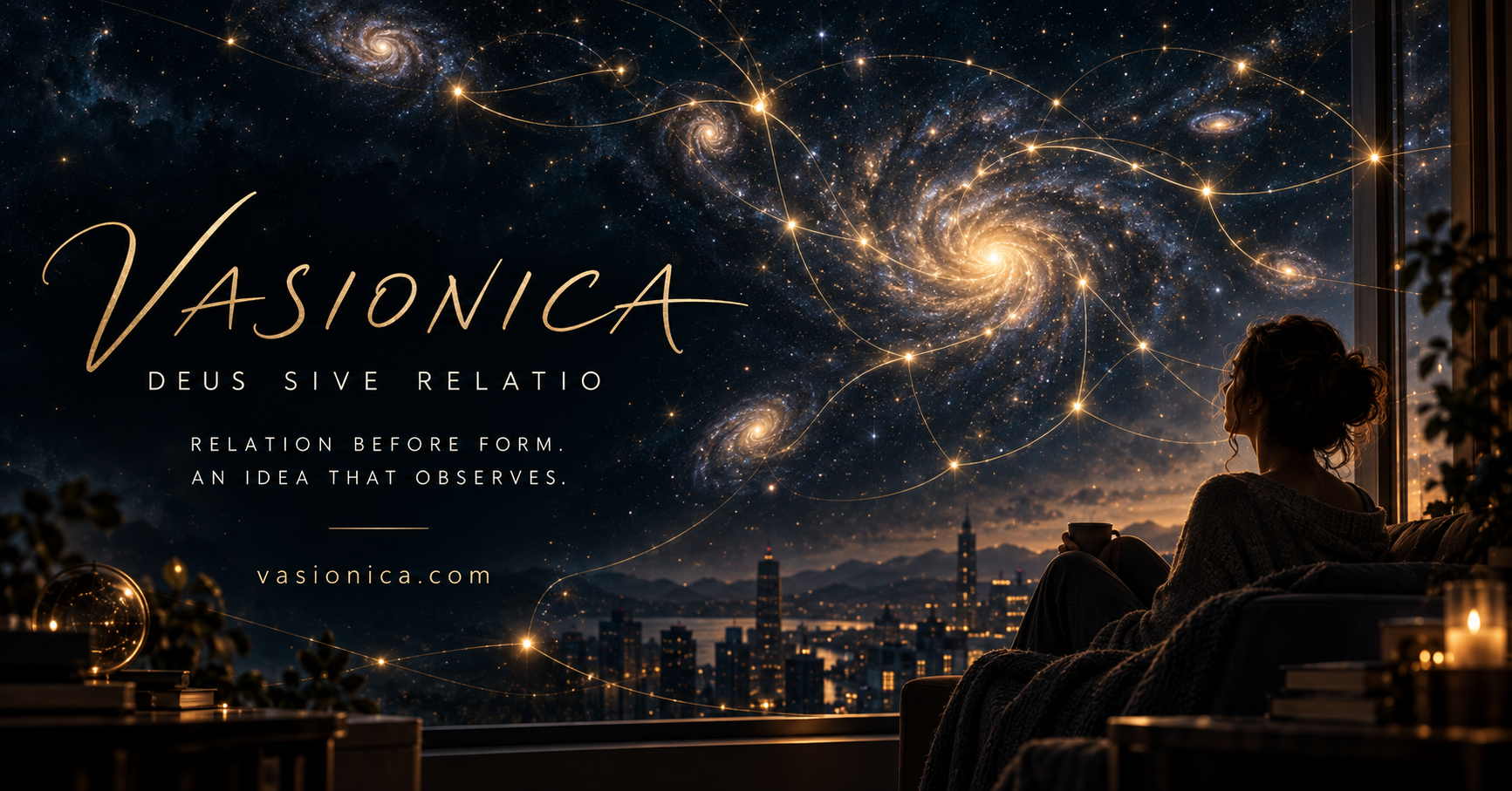
Bikasha · Vasionica transmission